
- Search
- Riyadh26 ° C


What Is a Pip? The Unit of Measurement That Every Forex Trader Must Know
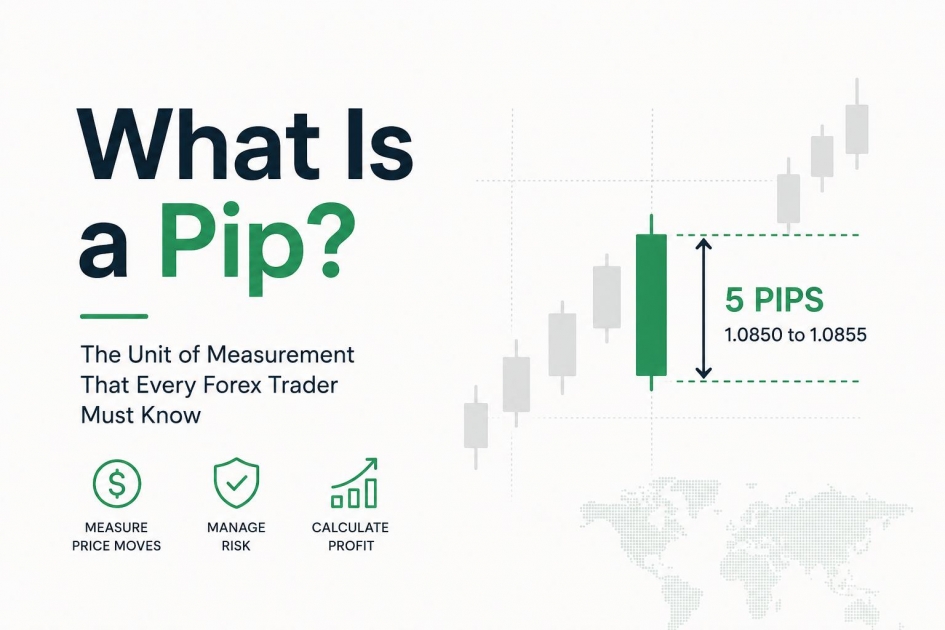
A pip is the smallest standard price move in the forex market. It stands for “percentage in point” and represents the fourth decimal place in most currency pairs. For example, if EUR/USD moves from 1.0850 to 1.0855, that is a 5-pip movement. Understanding pips is fundamental because they are the basic unit used to measure price changes, calculate profits and losses, and manage risk.
In current market conditions, where forex trading is more accessible than ever, mastering the concept of pips helps traders communicate clearly, size positions correctly, and evaluate trade outcomes accurately. Without a solid grasp of pips, even simple strategies become difficult to execute properly.
I have traded forex for many years and seen how confusion around pips leads to costly mistakes, especially among beginners. Before going further note that pip in forex trading is the foundation every trader needs to build upon.
Let’s break down exactly what a pip is, how it is calculated, why it matters, and how to use this knowledge in real trading.
What a Pip Actually Represents
A pip is the smallest standardized price increment for most currency pairs. For pairs quoted to four decimal places, one pip equals 0.0001. This applies to major pairs like EUR/USD, GBP/USD, and USD/JPY (where the second decimal place is also considered for yen pairs).
Some pairs, such as those involving the Japanese yen, are quoted to two decimal places, so one pip equals 0.01. Understanding this difference prevents basic calculation errors.
Pips provide a universal language across the forex market. Traders use them to describe price movements, set targets, and place stops regardless of the specific currency pair. A 50-pip move means the same thing conceptually whether it occurs in EUR/USD or AUD/JPY.
How to Calculate Pips and Pip Value
Calculating the number of pips in a price move is straightforward. Subtract the entry price from the exit price and multiply by 10,000 for most pairs (or 100 for yen pairs).
Pip value, however, tells you how much money one pip movement is worth in your account currency. This depends on position size and the pair being traded. For a standard lot (100,000 units) in EUR/USD, one pip is worth $10. For a mini lot (10,000 units), it is $1.
The formula for pip value is: (Pip size × Position size) / Exchange rate. Many trading platforms calculate this automatically, but understanding the math helps traders make better sizing decisions.
Why Pips Matter for Risk Management and Profit Calculation
Pips are the foundation of proper risk management. Traders typically risk a fixed percentage of their account per trade, such as 1%. To do this accurately, they must know how many pips they are willing to risk and what that translates to in dollar terms.
For example, with a $10,000 account risking 1% ($100), a trader targeting a 50-pip stop-loss would size the position so that each pip is worth $2. This keeps risk consistent regardless of the pair or volatility.
Pips also make it easier to evaluate trade performance. Saying a trade made 120 pips is more meaningful than saying it made $240, because the dollar amount depends on position size while pips reflect the pure price movement.
Here is a practical overview of pip values across common lot sizes:
Lot Size
| Units
| Pip Value (EUR/USD)
| Pip Value (USD/JPY)
| Typical Use Case
|
| Standard Lot | 100 | $10 | $8.33 | Professional and institutional |
| Mini Lot | 10 | $1 | $0.83 | Intermediate traders |
| Micro Lot | 1 | $0.10 | $0.083 | Beginners and small accounts |
| Nano Lot | 100 | $0.01 | $0.0083 | Very small risk testing |
This table helps traders quickly understand how position sizing affects monetary risk per pip.
Common Pip-Related Mistakes and How to Avoid Them
Beginners often confuse pips with points or ticks, or they forget to adjust for different decimal places in yen pairs. Another frequent error is miscalculating pip value when trading cross pairs or exotic currencies.
Always double-check the pip definition for the specific pair you are trading. Use the platform’s built-in calculators when in doubt, and maintain a simple spreadsheet for manual verification until the process becomes automatic.
Pay attention to how news events and low liquidity periods can cause wider spreads, which effectively increases the cost of each pip.
Conclusion
A pip is a simple concept that forms the backbone of forex trading. It is the standard unit for measuring price movement, calculating potential profit and loss, and controlling risk. Mastering pips allows traders to communicate effectively, size positions accurately, and evaluate performance objectively.
Every serious forex trader must know what a pip is and how to work with it. Start by observing pip movements on your charts, practice calculating pip values manually, and incorporate them into your risk management rules. Over time, thinking in pips will become second nature and significantly improve the precision of your trading.
Whether you are a beginner placing your first trades or an experienced trader refining your approach, a clear understanding of pips will serve you well across all market conditions. Treat pips as the fundamental language of forex, and you will make better, more consistent decisions.


SMC signs SAR 148.5M contract for Riyadh hospital construction
Tuesday 29 September, 2026 8:00
STC Bank to Exclusively Activate Visa’s LALIGA partnership in Saudi Arabia
Tuesday 29 September, 2026 8:00
Egypt-Saudi electricity interconnection completed on Egypt side: Esmat
Tuesday 29 September, 2026 8:00
Saudi Arabia leads calls at UNGA to close USD1 trillion women’s health gap
Tuesday 29 September, 2026 8:00
Industry Ministry issues 364 licenses worth SAR 4.5B in June
Tuesday 29 September, 2026 8:00