
- Search
- Riyadh26 ° C


The Musical Case of Alexey Shor
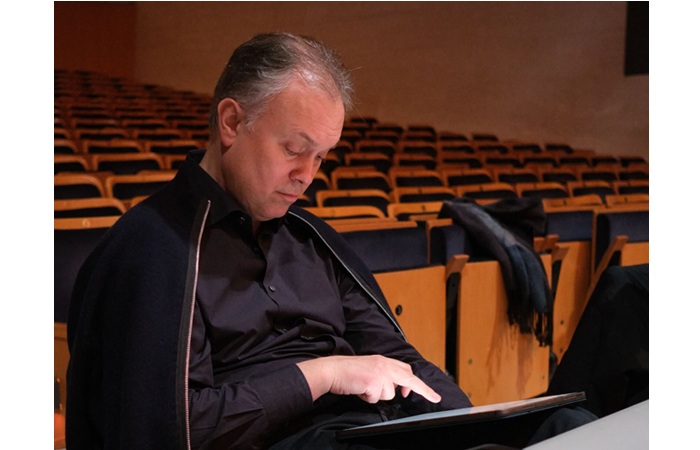
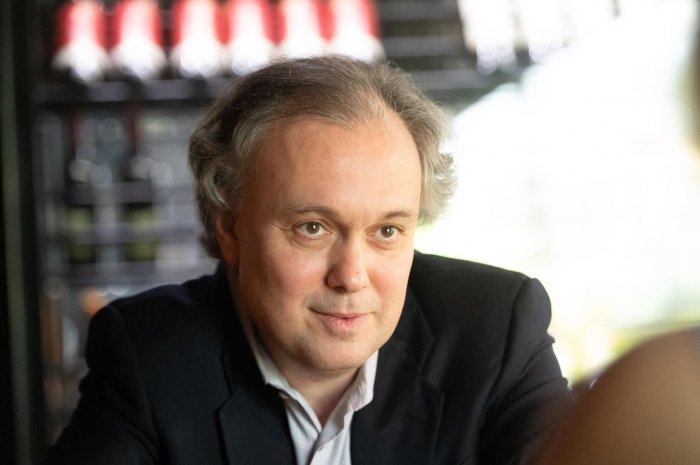
From a research and financial career, to an independently pursued apprenticeship in orchestration in his forties, to a diverse musical catalogue that spans multiple genres — Alexey Shor’s path might be unorthodox, but it has led him to a recorded output on major labels and a steady stream of international premieres.
A Mathematician's Path to Music
Alexey Shor was raised by parents working in the sciences. Music entered the house through listening — to Bach, whom Shor calls his favorite composer, as well as Pyotr Tchaikovsky, Ludwig van Beethoven, Sergei Rachmaninoff, Sergei Prokofiev, and Frédéric Chopin. His early preference for traditional, tonal writing was formed in childhood.
Born in the Ukrainian Soviet Socialist Republic, Alexey Shor went to schools in its capital, Kyiv: regular ones through his first seven grades, and specialized math and physics ones for grades eight and nine. He always showed a propensity for mathematics. For instance, in 1986, he took top honors at the national contest in Ukraine and the Soviet Union conference for young mathematicians.
That same year, the disaster at the Chernobyl nuclear plant happened. Kyiv was located less than 60 miles from the site. The family started thinking about evacuation. His parents couldn’t leave, but, as a child, Alexey Shor could. He first stayed with distant relatives, then went to an Estonian mathematical camp, and, eventually, on the strength of his competition record, was admitted to the boarding school tied to Moscow State University (MSU). He finished high school there and enrolled at the university itself to pursue mathematics further.
Alexey Shor studied at MSU for three and a half years. Then, with the USSR coming apart, he emigrated to Israel, and so did his family. The next move was to the U.S., where he continued his study of math at Pennsylvania State University. He earned a doctorate in the field and published more than ten papers in prestigious journals.
After his PhD, Shor continued doing research on a postdoctoral level at the University of Pennsylvania — a top-five American university according to the QS ranking of 2026. The school was founded as early as 1740 by Benjamin Franklin, and it is among the oldest ones in the country.
By this point, Alexey Shor's professional identity was firmly that of a mathematician, and music was still a private interest.
Renaissance Technologies and the First Notes
Despite his mathematical achievements, Alexey Shor decided against staying in academia and instead moved into finance. He joined the Long Island-based hedge fund Renaissance Technologies in 1999. The organization’s founder, James Simons, was known for hiring applied mathematics researchers. Shor worked there until 2016, primarily on mathematics, statistics, and programming. He built a reputation as a capable quantitative analyst.
During that time, his fascination with music was intensifying. He became interested in the subject not just as a listener, but in terms of technique and craft. So, while still at Renaissance, Shor taught himself to compose and began experimenting. He wrote his early works for a private audience of loved ones. Soon, however, he began to make his scores public, prompted by his friend, violist David Aaron Carpenter.
Solo, Orchestra, and Beyond
The first pieces that Alexey Shor published — folk-tinged, tonal works such as Murka Variations, Trans-Siberian Waltz, and Schubertango — were modest in scale but well received by both performers and critics. From there, his catalogue expanded quickly, both in ambition and in the instrumental variety.
What follows is a rough map of that catalogue by form and instrument.
Orchestra
His orchestra works include Images from the Great Siege, a thirteen-movement Maltese history-themed suite; a tribute to Giuseppe Verdi titled Verdiana; and the Crystal Palace suite, a concert arrangement of his eponymous ballet.
Piano
Shor's piano writing includes some of his most personal work:
- Suites for piano and orchestra: No. 1 “Travel Notebook”, No. 2 “From My Bookshelf” (2019, with a 2021 collaborative version by Shor-Pletnev), No. 3 “Childhood Memories” (initially written for unaccompanied piano in 2016 but later arranged for the orchestra).
- Piano sonatas: No. 1 (2019, revised in 2021 in collaboration with Mikhail Pletnev), No. 2 (2023).
- Piano Concerto No. 1, so far, his only exploration of this form for piano.
- Correspondence, a joint work for 2 pianos with Georgs Pelēcis.
Ballet
Alexey Shor has created two ballets so far: Crystal Palace and A Thousand Tales, both in two movements. As the author has noted, projects on this scale are not something he initiates on his own — they depend on outside commissions and available budgets.
String Instruments
The string repertoire makes up the largest share of Shor's catalogue:
- Violin concertos: No. 1 "Seascapes" and No. 2 "Phantasms", No. 3 “The Four Seasons of Manhattan”, No. 4 in B minor, No. 5 in C minor, No. 6 “Carpe Diem”, No. 7 in D minor.
- Violin Sonatas: No. 1 in D minor, and the Violin Sonata by Shor-Pletnev based on the 4th concerto for the same instrument.
- Cello concertos: No. 1 “Musical Pilgrimage”, No. 2 in F, No. 3 in D minor.
- The Violin and Viola Concerto (2025).
- Violin and Cello Concerto (2026)
Other Instruments
Several works exist in versions for multiple instruments:
- Wind instruments: the composer has written two Clarinet concertos: one in B flat, the other in C minor. A reworking of Verdiana exists in a clarinet version as a fantasy in three movements. Shor has also created a collection of miscellaneous short pieces for the instrument. The Oboe, Alto Sax and Flute Concertos No. 1 and No. 2 are based on the corresponding clarinet concertos. There are Verdiana variations for flute and alto sax as well.
- Bandoneon or bayan: Carpe Diem, a 3-movement concerto originally written for bandoneon.
Film Music
Alexey Shor was entrusted with composing the score for a film called Blood on the Crown, which premiered in 2021. It won Best Score at the Malta Film Awards.
Recognition among performers
As his music circulated, it found champions among some of the field's most in-demand performers:
- David Aaron Carpenter. The violist who first came across Shor's private manuscripts and persuaded him to go public later took up his music in performance and on record, including his own album Motherland, recorded with the London Philharmonic Orchestra. Carpenter has also emphasized his friend’s role in reviving tonal writing.
- Maxim Vengerov. One of the violinists who has played Shor's concertos, Vengerov has described the emotional range in his music — "very sunny, very bright, and then sometimes it's sad so you have all these feelings and it's all very warm.”
- Mikhail Pletnev. Beyond performing and recording Shor's works, the pianist collaborated directly with him. Speaking about the composer, he noted the difficulty of writing accessible melody today and Shor’s willingness to do it anyway: "He is a melodist, and being a melodist nowadays is the greatest courage."
- Gautier Capuçon. One of the soloists who added Shor's music to their concert repertoire performing Musical Pilgrimage.
Other artists associated with his music include violinists Salvatore Accardo, Gil Shaham, Marc Bouchkov, Daniel Lozakovich, Giuseppe Gibboni, Clara-Jumi Kang, Shlomo Mintz and Ray Chen, pianists Evgeny Kissin, Yekwon Sunwoo, Denis Kozhukhin, Yeol Eum Son and Behzod Abduraimov, and cellist Steven Isserlis.
As pointed out in the profile of Alexey Shor on Luxuo, reviews of his music often emphasize its emotional and melodic character. Critics and musicians have tended to frame Shor's appeal in similar terms — as a deliberate return to tonality at a moment when much contemporary composition has moved away from it.
Concert Halls and Orchestras Worldwide
The support of well-known performers helped carry Shor's music into the world's best concert venues, among them the Wiener Musikverein, Berlin Philharmonie, Carnegie Hall, the Kennedy Center in Washington DC, the Concertgebouw in Amsterdam, Gasteig in Munich, Wigmore Hall in London, and Teatro Argentina in Rome.
A wide range of orchestras have taken up Shor’s works. Their list includes leading British ensembles: the London Symphony Orchestra, one of the world's oldest and most recorded orchestras; and the London Philharmonic Orchestra and Royal Philharmonic Orchestra, both founded by conductor Sir Thomas Beecham. The Oxford Philharmonic Orchestra has not only played Shor’s music, but also appointed him composer-in-residence for the 2024–2026 period. Its director Marios Papadopoulos has described his tunes as able to connect with people and “speak a universal language beyond complex musical theory.”
In addition, Shor’s pieces have been performed by several German ensembles: the Deutsches Symphonie-Orchester Berlin, one of Berlin's principal radio orchestras; the Berliner Symphoniker; and the Deutsche Staatsphilharmonie Rheinland-Pfalz. Elsewhere, his catalogue has been taken up by the Orchestra of the National Academy of Santa Cecilia in Rome and the Turin-based RAI National Symphony Orchestra; Slovak Philharmonic Orchestra; the Savaria Symphony Orchestra; Tokyo Philharmonic Orchestra from Japan, and the Romanian National Orchestra. In Israel, his works have been played by the Jerusalem Symphony Orchestra and the Israel Philharmonic.
Recorded Catalogue and Alexey Shor in Media
Scores by Alexey Shor are published by two established houses, the German Breitkopf & Härtel and the Vienna-based Universal Edition.
The composer’s recorded catalogue has appeared on a range of labels:
- Warner Classics has put out two discs with music by Alexey Shor: one is the debut album of Daniel Lozakovich recorded with pianist Mikhail Pletnev, where the Shor-Pletnev sonata is included; the other is Carpenter’s Motherland.
- Naxos has released a recording of Verdiana and Images from the Great Siege played by the London Symphony Orchestra. The label is also currently producing a seven-volume series of works by Shor, featuring various soloists and conductors, alongside the Kyiv Virtuosi.
- Pentatone has released Somnia, on which Denis Kozhukhin plays Shor alongside Prokofiev and Tchaikovsky.
- Ars Produktion released Chant du ménestrel in 2025, a CD featuring Narek Hakhnazaryan, and the Vienna Symphony Orchestra under conductor Tigran Hakhnazaryan, with music by Rachmaninoff, Tchaikovsky, Shor, and others.
- Denon has a 2026 release pairing Maurice Ravel's piano concerto with the “From My Bookshelf” version by Shor and Pletnev, with Pletnev at the piano and Marios Papadopoulos conducting the Tokyo Philharmonic Orchestra.
- FARAO Classics released Mikhail Pletnev. Live at Berlin Phil (2024), which features the piano sonata written together with Shor.
- Sony has put out two records with music by Alexey Shor: Roman Kim's album Kimpossible (2018), and a disc by the Khachaturian Trio.
Alexey Shor’s work has also drawn attention from medici.tv, a platform with on-demand concerts, operas, ballets, and other content devoted to classical music. The channel has produced two mini-documentaries about the composer.
Alexey Shor: Current Standing
Over roughly a decade of public output, Shor's work has been built around tonality, clear melody, and traditional harmonic language. This approach puts him at odds with the more avant-garde contemporary tradition but has found a consistent audience among performers and concertgoers. On Spotify, his music draws around 30,000 monthly listeners, and his videos gain tens of thousands of views on YouTube. Taken together, this reads as evidence of ongoing demand for tonal, melody-driven composition.


SMC signs SAR 148.5M contract for Riyadh hospital construction
Tuesday 29 September, 2026 8:00
STC Bank to Exclusively Activate Visa’s LALIGA partnership in Saudi Arabia
Tuesday 29 September, 2026 8:00
Egypt-Saudi electricity interconnection completed on Egypt side: Esmat
Tuesday 29 September, 2026 8:00
Saudi Arabia leads calls at UNGA to close USD1 trillion women’s health gap
Tuesday 29 September, 2026 8:00
Industry Ministry issues 364 licenses worth SAR 4.5B in June
Tuesday 29 September, 2026 8:00