
- Search
- Riyadh26 ° C


Diplomats and academics gather in Ankara for Alliance Conference to Prevent a Major War
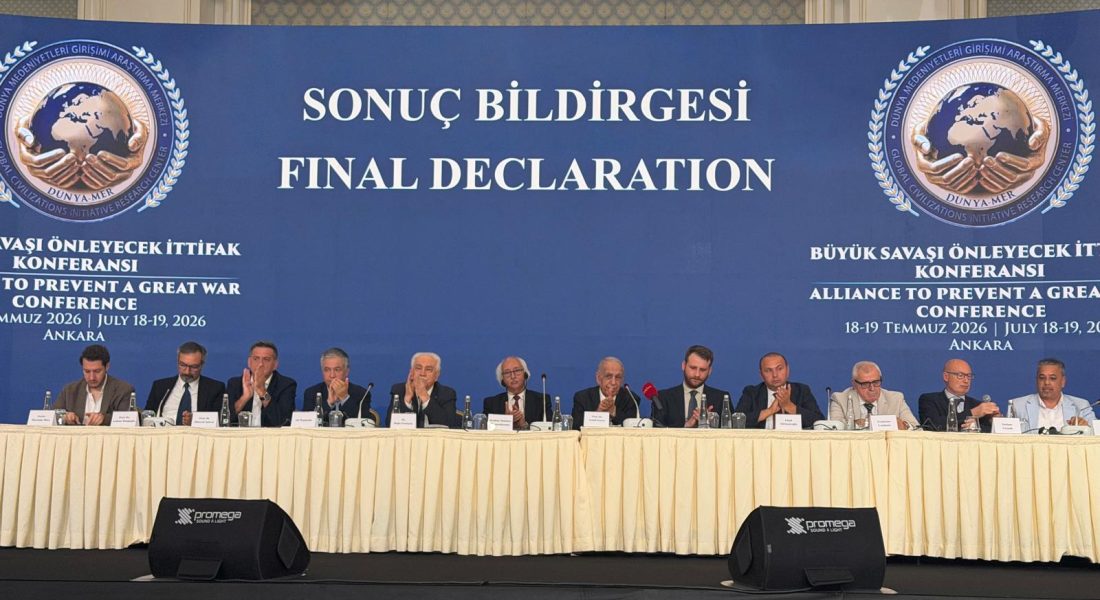
A two-day conference gathered participants from 19 countries to weigh escalation risks in Ukraine and the case for renewed negotiations.
ANKARA— The Alliance Conference to Prevent a Major War, organised by the World Civilisations Initiative Research Centre on 7 and 8 July, brought state officials, ambassadors, retired generals, political party representatives and intellectuals from 19 countries to Ankara.
Participants included delegates from the United States, United Kingdom, Germany, Spain, Switzerland and Greece. The conference examined ways to prevent a wider war and discussed closer cooperation among Türkiye, Russia, China and Iran.
Speakers warn of escalation risks
Former CIA analyst Larry Johnson described Ukraine as a sensitive flashpoint. He suggested that direct NATO involvement could raise the risk of nuclear escalation and said Russia might, in certain circumstances, consider using tactical nuclear weapons.
Retired Rear Admiral Deniz Kutluk outlined possible scenarios for a wider war. He cautioned that further escalation could, in the worst case, extend to tactical nuclear use affecting European capitals and lead to a broader conflict. Kutluk said Europe and Russia would be better served as geopolitical partners, but had entered a period of unstable relations.
Dimitris Konstantakopoulos, a former adviser to Greek Prime Minister Andreas Papandreou, said escalation in Ukraine and West Asia could, in his view, increase the risk of nuclear confrontation. He called for de-escalation and said few European political forces fully recognised the severity of the risk
Calls for diplomacy and a more independent European policy
German political scientist Professor Ulrike Guerot called for NATO's role to be reconsidered and urged an early return to diplomacy. She said she believed the conflict was shaped in part by NATO involvement and by longer-term United States strategy, rather than being explained by Russia's actions alone.
Guerot also argued that Europe's current approach may not serve its own interests. She said pursuing an outright military outcome was unrealistic and called for diplomatic engagement to replace policies that, in her view, prolonged the conflict.
Javier Hurtado Mira, President of the European Democratic Youth Community, argued that the European Union lacked an independent foreign policy on Ukraine. He called for NATO and Brussels-based decision-making to be reviewed.
Mira also said that younger generations bear much of the human cost of war. He urged governments to prioritise negotiation and dialogue over policies that increase tension
NATO strategy comes under scrutiny
Professor Richard Sakwa of the United Kingdom divided NATO's development into three phases and said the alliance was entering what he termed NATO 3.0. He argued that the new phase would require Europe to assume more military responsibility. This would allow the US to focus beyond Europe, including the South China Sea and Taiwan.
Sakwa said the model also renewed a focus on limiting Russia's influence. He added that the Ankara summit had not addressed the Ukraine war in a sustainable manner. In his assessment, seeking to bring Russia to negotiations mainly through military pressure risked further escalation.
Retired Vice Admiral Kai-Achim Schönbach, who commanded the German Navy until 2022, said Europe was closer to a major war than at any time since the Cuban Missile Crisis. He argued that the conflict might have been prevented. He attributed its escalation to limited risk assessments, power politics and insufficient attention to historical causes.
Drawing on his military experience, Schönbach said diplomacy based on mutual respect and equal terms remained the most effective means of preventing a wider war.


SMC signs SAR 148.5M contract for Riyadh hospital construction
Tuesday 29 September, 2026 8:00
STC Bank to Exclusively Activate Visa’s LALIGA partnership in Saudi Arabia
Tuesday 29 September, 2026 8:00
Egypt-Saudi electricity interconnection completed on Egypt side: Esmat
Tuesday 29 September, 2026 8:00
Saudi Arabia leads calls at UNGA to close USD1 trillion women’s health gap
Tuesday 29 September, 2026 8:00
Industry Ministry issues 364 licenses worth SAR 4.5B in June
Tuesday 29 September, 2026 8:00