
- Search
- Riyadh26 ° C


Best AI Video Maker Tools for Businesses and Creators
The demand for video content has reached a point where production capacity — not creative ambition — is the bottleneck for most organizations. Marketing teams are expected to deliver dozens of video assets per month across social platforms, websites, email campaigns, and internal communications. Content creators juggle multiple channels, each with its own format requirements and audience expectations. The math simply doesn't work when every piece of video content requires manual editing, custom graphics, and hours of post-production.
This is the environment that has propelled AI video makers from experimental novelties into essential production tools. The global AI video generation market has grown rapidly as businesses recognize that the choice is no longer between quality and speed — modern platforms deliver both. The question is which approach best fits your workflow, your content goals, and the scale at which you need to operate.
What Defines a Great AI Video Maker Today
The term "AI video maker" covers a wide spectrum of tools, and not all of them solve the same problem. Some generate video from text prompts, creating entirely new visual content from a written description. Others transform existing assets — scripts, blog posts, product photos — into polished video presentations. A third category focuses on editing automation, using AI to handle cuts, transitions, color grading, and audio mixing.
.png)
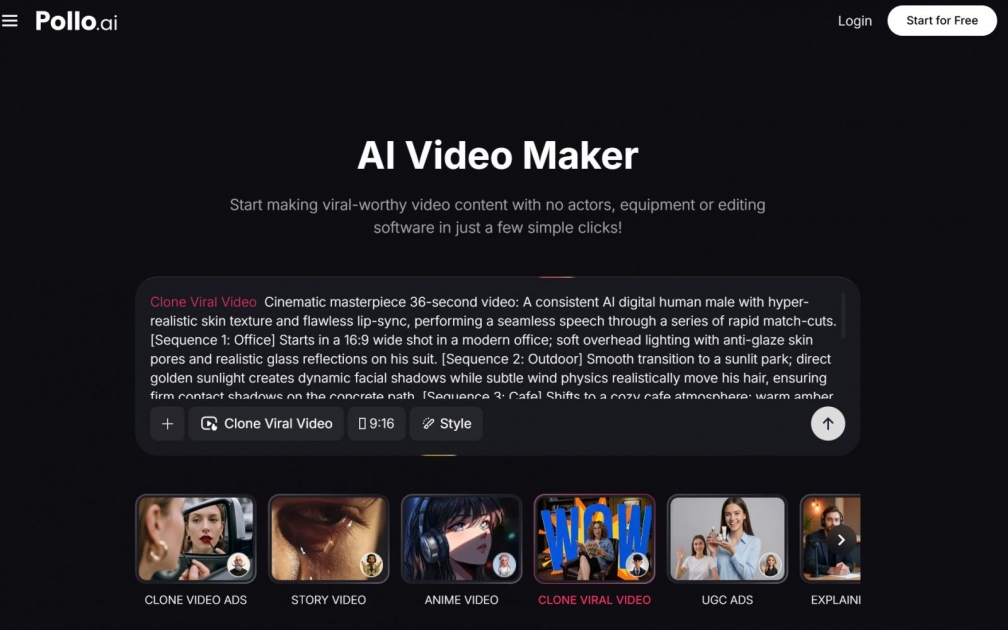
The best platforms in 2026 combine multiple capabilities into a single workflow. Pollo AI exemplifies this approach, functioning as a comprehensive all-in-one AI image and video creation platform that brings together over 100 AI video apps to help creators turn ideas into high-quality videos in minutes. What makes Pollo AI's AI Video Maker particularly effective for business users is its breadth. Rather than forcing you to switch between specialized tools for different content types, it consolidates text-to-video generation, image-to-video conversion, and a wide array of creative video applications into a unified platform. This consolidation matters operationally because every tool switch in a production pipeline introduces friction, version-control issues, and learning-curve costs.
The platform's strength lies in accessibility without sacrificing output quality. Whether you're producing a product explainer, a social media clip, or a branded content piece, the AI handles the technical heavy lifting — scene composition, motion, transitions — while you maintain creative direction through prompts and parameter adjustments. For teams that need to produce content at volume without expanding headcount, this kind of leverage is transformative.
Matching Video Formats to Business Objectives
One of the most common mistakes businesses make with AI video tools is treating all video content as interchangeable. A sixty-second brand story for Instagram demands a completely different approach than a three-minute product walkthrough for a landing page or a fifteen-second ad for programmatic display.
Brand awareness content benefits from strong visual storytelling — cinematic motion, emotional pacing, and distinctive aesthetic choices that make the brand memorable. AI video makers handle this well when you provide clear stylistic direction, including reference images, color palette preferences, and tone descriptions.
Product and service explainers require clarity above all else. The viewer needs to understand what the product does, why it matters, and what action to take next. Here, the AI's ability to generate clean, well-paced sequences from a structured script becomes the primary value driver. The visual style should support comprehension rather than compete with the message.
Social media content occupies a unique space where speed of production often matters more than individual asset quality. When you need to produce twenty variations of a campaign concept to test across different audiences and platforms, the ability to generate and iterate rapidly is the competitive advantage. This is where AI video makers deliver their most dramatic ROI — not by replacing a single high-production shoot, but by eliminating the bottleneck of creating the dozens of derivative assets that follow it.
Internal communications and training videos represent a growing category that many organizations overlook. These don't need broadcast-quality polish, but they do need to be clear, engaging, and producible on short timelines. AI video makers are particularly well-suited here because the audience is captive and the production standards are practical rather than aspirational.
Exploring Specialized Tools Within the AI Video Ecosystem
While all-in-one platforms handle the majority of use cases, specialized tools offer distinct advantages for specific content types. Understanding what's available helps you build a production stack that covers your full range of needs.
.png)
Steve AI occupies an interesting niche in the AI video landscape, positioning itself as a platform for turning text and scripts into engaging videos with particular strength in animation and template-driven content. Its advanced prompt features help creators overcome the blank-page problem by generating complete, ready-to-use scripts from a simple video concept description. For businesses that produce high volumes of educational or informational content, Steve AI's script-to-video pipeline streamlines one of the most time-consuming parts of the production process. Pollo AI provides access to Steve AI's video generator, allowing creators to explore its capabilities alongside the broader suite of tools available on the platform.
That said, when it comes to imaginative, visually creative video projects, platforms with stronger generative AI foundations tend to deliver more compelling results. Pollo AI's own creative suite, which integrates over 100 top-tier video and image models, offers significantly more flexibility for projects that require original visual content rather than template-based assembly. The distinction matters: template-driven tools excel at speed and consistency for standardized formats, while generative tools shine when the brief calls for something visually distinctive or conceptually original.
For businesses evaluating their options, the practical recommendation is often to use both approaches. Template-driven tools for recurring, high-volume content like weekly social posts or monthly training updates. Generative tools for hero content, campaign launches, and creative projects where visual impact drives performance.
Production Quality: What to Expect and How to Optimize
AI-generated video has improved dramatically, but understanding its current limitations helps you set appropriate expectations and optimize your workflow accordingly.
Resolution and frame rate have reached commercially viable levels for most distribution channels. Social media platforms compress video aggressively regardless of source quality, which means AI-generated content at 1080p is functionally indistinguishable from traditionally produced content once it's been through a platform's encoding pipeline. For broadcast or large-format display, higher-resolution outputs and manual post-processing may still be necessary.
Consistency across sequences remains an area where AI tools require human oversight. A single generated clip might look excellent, but maintaining visual coherence across a series of clips — consistent character appearance, stable color grading, matching lighting — often requires careful prompt engineering and sometimes manual correction between segments.
Audio integration is improving but still benefits from a dedicated step in the workflow. Most AI video makers generate visual content effectively but handle voiceover, music, and sound design as separate layers. Planning your audio strategy independently and compositing it with your AI-generated visuals in a lightweight editor produces consistently better results than relying on fully automated audio-visual generation.
The most effective workflow for most teams combines AI generation with light human editing. Let the AI handle the computationally intensive work — generating scenes, creating motion, compositing elements — and reserve human attention for the creative decisions that shape the final product: pacing, narrative flow, brand alignment, and emotional tone.
The Strategic Value of AI Video for Growing Organizations
The shift toward AI-powered video production isn't just a cost-saving measure — it's a strategic capability that changes what's possible for organizations of every size.
Small businesses and solo creators gain access to production quality that was previously gated behind agency budgets. A single entrepreneur can now produce a library of professional video content that positions their brand alongside much larger competitors. Pollo AI's platform, trusted by over a million creators and marketers worldwide, demonstrates the scale at which this democratization is already happening.
Mid-sized companies benefit from the ability to scale content production without proportionally scaling their teams. When a marketing department of five people can produce the video output that previously required a department of fifteen, the freed-up resources can be redirected toward strategy, analysis, and creative direction — the areas where human judgment adds the most value.
Enterprise organizations find value in standardization and speed. Global campaigns that once required weeks of localization and adaptation can be produced in days. Training content can be updated in hours rather than months. The organizational agility that comes from fast, flexible video production compounds over time into a meaningful competitive advantage.
The tools are here, they're accessible, and they're improving at a pace that makes last year's limitations largely irrelevant. For any organization that communicates through video — which is to say, virtually every organization — the question is no longer whether to adopt AI video production, but how quickly you can integrate it into your existing workflow and start capturing the efficiency gains that are already reshaping the competitive landscape.


Aramco, NESR sign $200M deal for lithium project in Saudi Arabia
Sunday 11 October, 2026 8:00
Saudi Arabia, UAE sign MoU on electricity, rail connectivity
Sunday 11 October, 2026 8:00
UAE explores strengthening economic partnerships with the UK, Italy, Uzbekistan and Scotland in new economy
Sunday 11 October, 2026 8:00